Key Points:
- ‘GS1 Sunrise 27’ heralds the widespread adoption of 2D barcodes on retail products
- 2D barcodes increase visibility throughout the supply chain
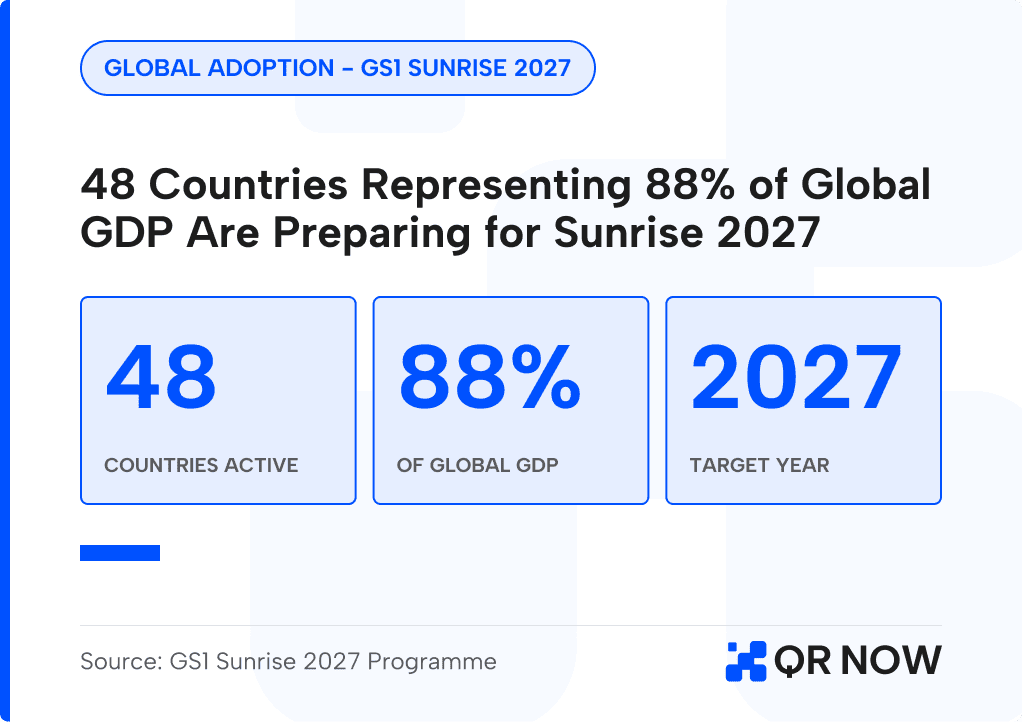
- The transition is already live in 48 countries, touching 88% of global GDP and trillions of dollars in commerce
- Shoppers are driving the shift: 79% are more likely to buy products that contain extra detail on allergens, sourcing, and sustainability; something only 2D barcodes can deliver
- 2026 is the critical data audit year. Brands that fail to structure stock-keeping unit (SKU) data for product passports by Q2 2026 risk those products disappearing at checkout
Sunrise 27 Marks the Dawn a New Era for Retail
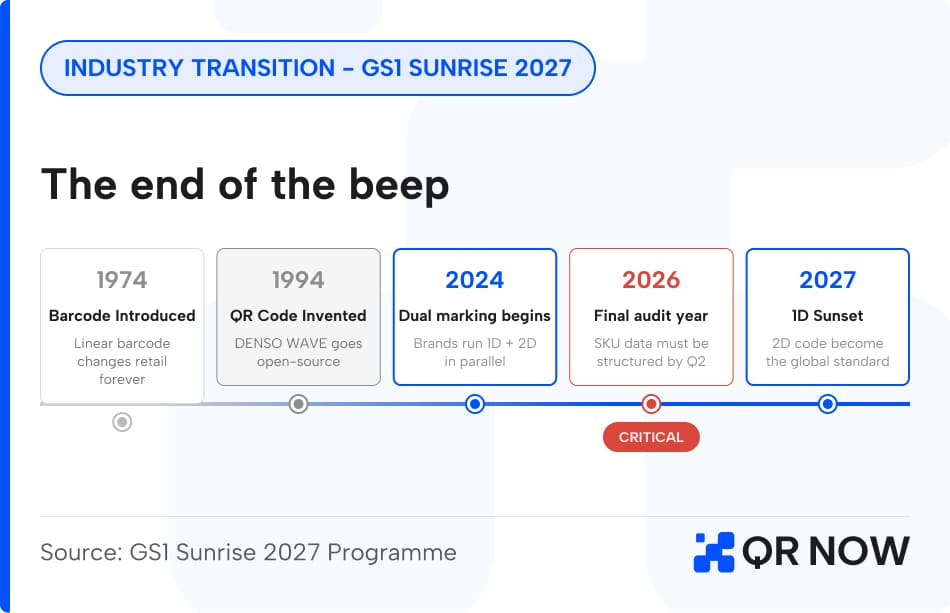
The migration from 1D to 2D barcodes is called ‘Sunrise 27’ and is organized by GS1, the global supply-chain standards body. This move marks the biggest shift in retail since the barcode was launched way back in 1974.
Two-dimensional codes are already a common sight on physical products, event and travel tickets, and more, but in 2026, brands must adapt their packaging to include 2D barcodes, or their product cannot be read.
There are several 2D barcode options available to brands, such as the QR code and the GS1 DataMatrix code. Brands will need to decide which 2D codes suit their requirements from a supply chain data and packaging size perspective.
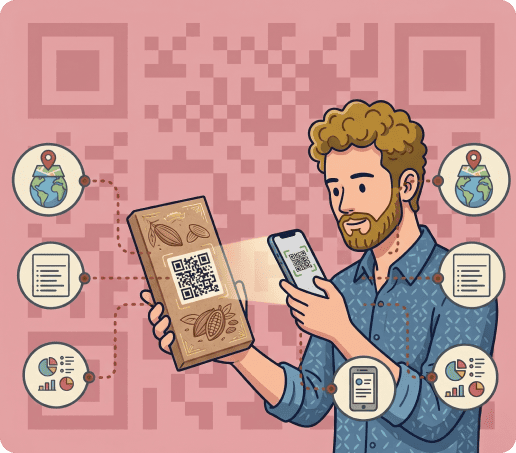
A 2024 GS1 survey found that 79% of consumers say they would be more likely to purchase products if they could use their smartphone to scan a code that would give additional product information, such as nutrition, materials, ingredients, and the country of origin.
Retail Gets Ready for the 2D Era
In 2026, global retail enters its final year of preparation for the end of the barcode. For more than 50 years, the checkout experience has been defined by a single sound: beep. That sound is now on borrowed time.
Right now, across global supply chains:
- Checkout systems are being upgraded
- Packaging is being redesigned
- Product data is being restructured
What Businesses Must Do Now
The clock is ticking for brands to get ready for the switchover to 2D barcodes. So, what should businesses be doing now before the 1D barcode becomes obsolete?
Here is a four-step checklist:
-
Treat product data as checkout-critical
Two-dimensional codes instantly reveal weak or incomplete product data. Brands must ensure core attributes are structured, accurate, and accessible.
-
Introduce dual marking on packaging
Most companies will run 1D and 2D codes in parallel during the transition. Packaging decisions made in 2026 will still be on shelves in 2027.
-
Confirm checkout and scanner readiness
Retailers must ensure point-of-sale (POS) systems can scan 2D codes at full speed under real-world conditions. Any friction shows up immediately to consumers.
-
Prepare for digital-first compliance and recalls
Regulators increasingly expect product information to be accessible digitally. Two-dimensional codes enable faster, more targeted responses when issues arise.
None of these actions requires new technology. They require alignment. And alignment is what Sunrise 2027 enforces.
Why This Matters Now
The shift towards 2D barcodes that can hold much more information has been driven by sustainability and regulatory demands. Also, physical labels have limited space, while consumers expect digital-first experiences.
QR codes are operationally ready. Scanners, smartphones, and industrial systems already support them.
- Proprietary codes would slow adoption and fragment the market
- Open access codes like QR make Sunrise 2027 possible at a global scale
In retail, reliability is king, and QR codes deliver. With Sunrise 2027, packaging becomes a living product passport. In fact, QR codes with GS1 Digital Link let brands update information in real-time, without changing the code printed on packaging.
The result: A single scan gives every stakeholder, from shopper to regulator, the data they need, instantly and reliably.
How Sunrise 2027 Will Impact Retailers, Brands, and Consumers
GS1 expects all retailers to be equipped to scan two-dimensional barcodes at checkout and across supply chains by 2027. This is crucial, because retail is interconnected and interdependent. A brand’s product can be manufactured in one country, packaged in another, then distributed for sale in different regulatory regimes.
Therefore, any identification system at this scale must work everywhere, for everyone. While 1D barcodes were designed to identify products, 2D barcodes align retail systems, supply chains and regulators, and contain valuable information for consumers, empowering them to make more informed choices.
Benefits for consumers include:
- Instant information: Ingredients, allergens, sourcing, recycling instructions
- Trust and transparency: Scan a product and see verified, up-to-date data
- Empowered decisions: Compare, authenticate, or check safety alerts instantly
Benefits for business include:
- Faster checkouts: Scanners read 2D codes instantly, reducing friction
- Efficient recalls: Batch-level data is embedded in the code itself
- Simplified packaging: No need to cram every instruction on labels
- Global compliance: One code, multiple markets, fewer redesigns
How Keeping QR Open-Source Helps the Transition
The QR code has been around since 1994. Masahiro Hara and his team at DENSO WAVE in Japan developed the code to carry the increased information required in the manufacturing sector.
Crucially, the company elected to make the code public domain, open and freely usable, without enforcing patent rights, meaning that:
- No single company could monopolize it
- Retailers avoided vendor lock-in
- Governments faced no licensing barriers
Hara described the decision to make the QR code accessible to all as “successful”, because the code could only be adopted broadly if it became widely used across society.
That open-source decision is why Sunrise 2027 can now happen at a global scale. Today, 48 countries representing roughly 88% of global GDP are actively preparing for the switch to two-dimensional codes.
At a Glance: Comparing Two Leading 2D Codes
Two of the most common forms of two-dimensional barcodes are QR codes and GS1 DataMatrix codes. Here is a breakdown of how they differ:
| Feature | QR Code | GS1 DataMatrix |
|---|---|---|
| Ideal use | Retail checkout and consumer access | Small or regulated packaging (pharma, medical devices) |
| Scan Speed | Fast in real-world retail | Fast, but optimized for compact spaces |
| Data Capacity | High | Moderate |
| Consumer-Friendly | Yes, can be scanned by smartphones without apps | Rarely consumer-facing |
| Open Standard | Yes | Yes |
Note for brands: Most environments will require both legacy 1D and 2D codes during transition. QR codes drive consumer engagement, while GS1 DataMatrix secures regulatory compliance.
Get started with your first QR code today
Enjoy full access to QRNow and create custom QR codes that look professional and on-brand. Sign up in seconds and start creating immediately.

What’s the State of Play with the Sunrise 2027 Rollout?
Sunrise 2027 is already underway on a global scale. Retailers, manufacturers, and logistics providers across 48 countries representing roughly 88% of global GDP are actively preparing for the transition. Today, the 2D code is the backbone of a system that will connect supply chains, consumers, and regulators.
With the linear barcode being phased out by 2027, for brands, the urgency is real. 2026 is the final year to prepare. Align product data, update packaging, and ensure scanning infrastructure is ready. Delay means lost compliance, slower checkouts, and frustrated consumers.
Make sure your business does not get left behind in the migration to 2D barcodes, visit QRNow today to start creating future-proof codes for your product.